
WHOLEistic Balance: The Alignment Beneath Balance
Jun 20, 2026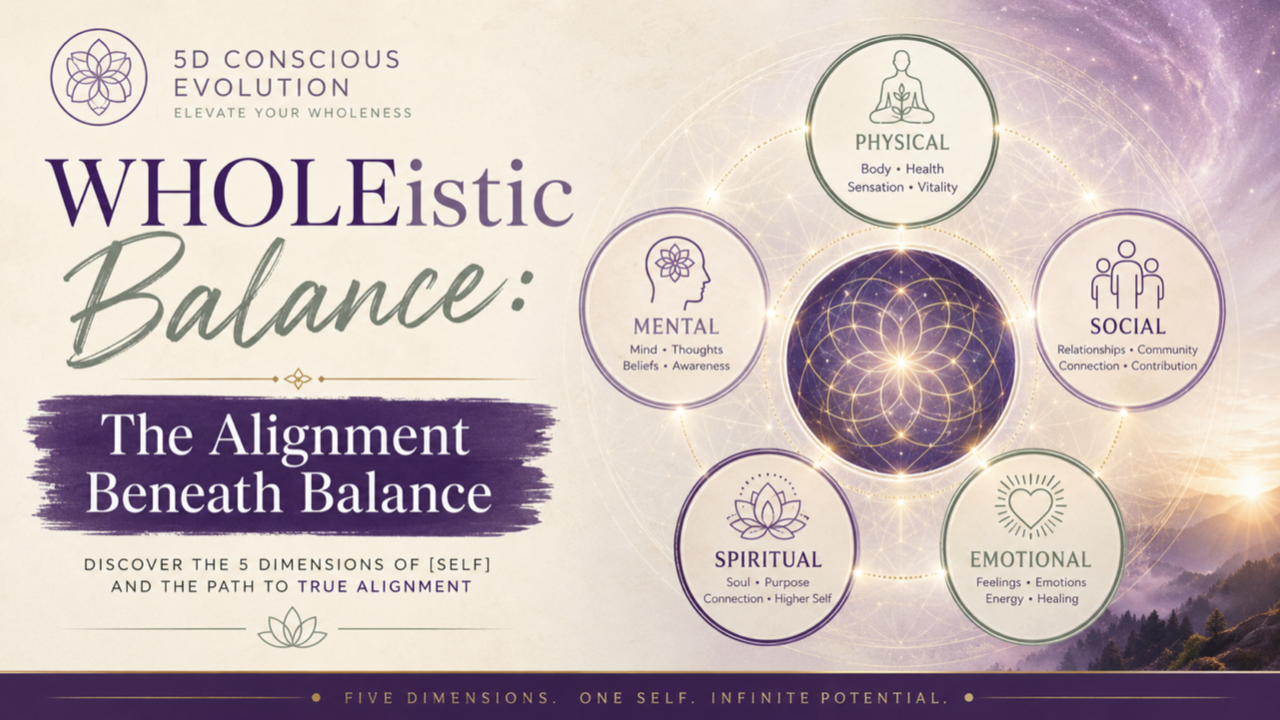
The idea of WHOLEistic Balance didn't begin with a business plan.
It began with a question.
Upon graduation from Bastyr University, our professors gave us a gift. Among the books was Evolutionary Herbalism: Science, Spirituality, and Medicine from the Heart of Nature by Sajah Popham. From the moment I opened it, I knew it would change the way I practiced herbalism.
I was incredibly grateful for the education I received at Bastyr. It gave me a strong scientific foundation and taught me how to understand the physical mechanisms behind health and disease. Yet I couldn't shake the feeling that there was another layer waiting to be explored—one that looked beyond chemistry and physiology into the realms of energetics, relationships, meaning, and the invisible patterns that influence both plants and people.
After finishing the book, I enrolled in Sajah's Alchemical Herbalism program. There I was introduced to an observation that would eventually help shape the entire WHOLEistic Balance framework.
Throughout history, healing traditions from around the world developed independently, often separated by geography, language, and culture. Yet many observed recurring patterns throughout nature. While they used different terminology and frameworks, these traditions consistently recognized that human beings are not separate from nature—we are expressions of it.
In Western traditions, these patterns were described through the Elements of Earth, Water, Air, Fire, and Ether. Traditional Chinese Medicine described relationships through Wood, Fire, Earth, Metal, and Water. Ayurveda recognizes combinations of elemental qualities expressed through the three doshas: Vata, Pitta, and Kapha. Greek Medicine understood health through the balance of the four humors: Blood (Sanguine), Yellow Bile (Choleric), Black Bile (Melancholic), Phlegm (Phlegmatic).
Although these systems differ in many ways, what fascinated me was not their differences—it was the recurring observation that nature appears to organize itself through patterns that repeat across plants, people, seasons, ecosystems, and life itself.
One of the teachings that most impacted me came from Ayurveda, one of the oldest continuously practiced systems of medicine in the world. Ayurveda teaches that every individual possesses a unique constitution. While everyone contains aspects of all three doshas, each person expresses them in different proportions. Because of this, two people may thrive under entirely different conditions. One person may benefit from stimulation and activity, while another requires grounding and rest. One person may flourish with structure and routine, while another thrives with greater flexibility.
What creates balance for one person may create imbalance for another.
This challenged a deeply ingrained assumption within modern culture—that there is a single blueprint for health, success, fulfillment, or even a balanced life.
That idea stayed with me.
Not long afterward, Vanessa and I began discussing the vision that would eventually become one of the foundational pillars of the Fifth Dimension Ascension Foundation. As we sat together in the sunshine dreaming about what we wanted to create, we asked ourselves a simple question:
What problem are we here to solve?
The answer came quickly:
Imbalance.
We saw expressions of imbalance everywhere. In the medical systems described above, symptoms are understood as the expression of an underlying imbalance. Yet imbalance is not limited to physical health. It can also appear as emotional patterns that drain us of energy, thought loops that erode our sense of [Self] worth, or the deep sense of isolation that arises when we feel disconnected from ourselves, from others, or from something greater than ourselves.
What these Elemental models ultimately teach—or perhaps reveal—is that beneath every symptom lies a pattern expressing itself throughout the whole. The symptom itself is rarely the root cause. Rather, it is the visible expression of a deeper imbalance moving through multiple layers of a system.
Take exhaustion as an example. While exhaustion may be experienced as a symptom, the underlying pattern is one of depletion. Energy production begins to diminish, tissues become less vital, processes begin to slow, and over time stagnation can emerge. What we eventually experience as exhaustion is simply the expression of that pattern reaching the level of conscious awareness. The symptom is not the pattern; it is the messenger revealing the pattern.
The more we studied these models, the more we realized they offered a way of understanding not only the parts, but the whole. If patterns express themselves throughout the layers of an individual, could the same principle apply at larger scales? Could the imbalance we see in the world be, at least in part, a reflection of the imbalance we experience within ourselves?
After all, societies are made of individuals. Communities are made of individuals. Relationships are made of individuals. The external world is constantly being shaped by the internal world of the people participating in it.
When we feel disconnected from ourselves, we often struggle to connect deeply with others. When we carry unresolved fear, we may become controlling or avoidant. When we feel chronically inadequate, we may seek validation through achievement, status, or external success. When we operate from scarcity, we often create competition where collaboration may have been possible.
While external circumstances absolutely influence our lives, many of the patterns we experience collectively begin as patterns within individuals. The same way an imbalance can express itself throughout the tissues of a body, human patterns can express themselves throughout relationships, communities, organizations, and cultures. The scale may change, but the pattern often remains the same.
This led us to an even deeper insight.
The modern world often attempts to fit everyone into the same box. We create systems, expectations, and definitions of success that assume everyone should live, think, learn, work, heal, and thrive in similar ways.
Yet nature doesn't work that way. No two trees grow exactly alike. No two ecosystems are identical. No two people are the same.
What if true balance isn't about fitting into someone else's definition of a balanced life? What if balance is unique to every individual?
That question became the foundation of everything that followed.
Drawing inspiration from ancient healing traditions, modern psychology, personal development, neuroscience, and our own lived experiences, we began developing what would eventually become the framework of WHOLEistic Balance.
(We intentionally spell WHOLEistic with the word WHOLE emphasized because balance is not achieved by focusing on one aspect of ourselves while neglecting the rest. True balance emerges when we honor and cultivate the wholeness of who we are.)
As we explored imbalance more deeply through the work we do with individuals, we noticed that struggles rarely existed in isolation. What appeared to be a physical problem often had emotional components. Emotional challenges influenced relationships. Relationships affected beliefs. Beliefs influenced purpose. Again and again, the same pattern emerged. Human beings seemed to be navigating life across several interconnected dimensions simultaneously.This realization eventually led us to identify five primary dimensions of [Self]: Physical, Emotional, Mental, Spiritual, and Social.
At its core, WHOLEistic Balance is the state of coherence between these dimensions.
The Physical dimension includes the body, health, movement, nutrition, sleep, and our relationship with the material world. The Emotional dimension relates to our feelings, emotional intelligence, and capacity for connection. The Mental dimension includes our thoughts, beliefs, perceptions, and the stories through which we interpret reality. The Spiritual dimension encompasses purpose, meaning, values, and our relationship with something greater than ourselves. The Social dimension encompasses our relationships, family, community, and sense of belonging.
While these dimensions can be discussed separately, they do not operate separately. They function as an interconnected system.
Most of us have experienced this firsthand. When we're physically exhausted, our emotional resilience often decreases. When a relationship is struggling, it becomes harder to focus mentally. When we feel disconnected from our purpose, even external success can feel strangely empty.
WHOLEistic Balance is not about perfection. It is about coherence. It is about creating alignment between the many dimensions of who we are so they begin working together rather than competing against one another.
And the most important thing these Elemental models teach, and we have experienced first hand is, balance looks different for everyone! WHOLEistic Balance is not about helping people live the same balanced life.It is about helping people discover the unique alignment that allows their life to become an authentic expression of who they truly are. For one person, balance may include building a business. For another, it may involve slowing down and spending more time with family. One person may thrive with structure while another flourishes with freedom.
WHOLEistic Balance is not a destination that everyone shares. It is a relationship unique to each individual. Part of the journey is learning what balance looks like for you. An equally important part is learning to respect the balance of others.
This understanding naturally leads to another question: If balance is the alignment of these dimensions of [Self], what happens when they fall out of alignment?
In yogic traditions, there is the concept of a central channel of energy running through the core of the body. This channel is often described as the pathway through which the chakras align and communicate. While there are many ways to understand this idea, I often think of the five dimensions of [Self] in a similar way. Imagine the Physical, Emotional, Mental, Spiritual, and Social dimensions aligned along a central axis. When these dimensions are coherent, there is a sense of wholeness. Our attention, energy, intentions, and actions move more freely throughout our lives. But when these dimensions fall out of alignment, internal friction is created. Perhaps your heart wants one thing while your mind insists on another. Perhaps your body is asking for rest while your habits keep pushing forward. Perhaps your deepest values conflict with the expectations of the people around you. When different parts of ourselves are pulling in different directions, we expend enormous amounts of energy maintaining the conflict. Many of the feelings we describe as burnout, overwhelm, confusion, frustration, and exhaustion are often symptoms of this internal misalignment.
The reality is that none of us arrive in adulthood as a blank slate. From the moment we enter the world, we are shaped by our biology, family systems, culture, education, relationships, successes, failures, wounds, and experiences. Over time we develop beliefs about ourselves and the world. We form emotional patterns, coping strategies, habits, and identities. Some of these adaptations serve us well. Others were developed simply to help us survive. As we grow older, it is common to become disconnected from aspects of ourselves in order to gain acceptance, avoid pain, or meet the expectations of others. We learn who we should be, often at the expense of discovering who we truly are.
WHOLEistic Balance is not about becoming someone new. It is about remembering who you are beneath the conditioning.
Many spiritual traditions teach that human beings are created by nature. The Bible tells us we were created in the image of God. Regardless of how one interprets that statement, one thing is clear: Human beings possess a remarkable capacity to create. We create relationships, businesses, families, communities, art, culture, meaning, and futures.
So how do we create? Our attention, beliefs, emotions, habits, relationships, and actions all participate in shaping the lives we create.
This is why alignment matters.
Over time, we've come to see that what most people describe as balance is often the outward expression of something deeper. Beneath balance lies alignment. When the dimensions of [Self] become more coherent, balance emerges naturally as a result. Modern neuroscience offers an interesting perspective on this process. Researchers have identified systems within the brain, such as the Reticular Activating System, that help determine what information reaches our conscious awareness. In many ways, the brain acts as a filter. What we consistently focus on, believe, and value influences what we notice in the world around us. The brain is not simply recording reality like a camera. It is constantly interpreting, organizing, predicting, and assigning meaning to experience. What we believe influences what we notice. What we notice influences how we feel. How we feel influences how we behave. How we behave influences the results we create. And those results often reinforce the beliefs we started with. Much of this process operates beneath conscious awareness. When we remain unconscious of our programming, it can feel as though life is simply happening to us. We repeat familiar patterns, encounter familiar challenges, and find ourselves stuck in familiar cycles without understanding why.
But awareness changes everything. The moment we become conscious of a pattern, we gain the ability to work with it. Transformation begins not by controlling every circumstance around us, but by becoming more conscious of what is happening within us.
Think about a time when you felt truly aligned. Maybe you had just received great news. Maybe you felt deeply connected to yourself. Maybe you were experiencing gratitude, joy, inspiration, or peace. What happened when you interacted with others that day? Did your presence affect the people around you? Chances are it did. When we are grounded, centered, and aligned, we naturally influence our environment. Our state affects our relationships. Our relationships affect our communities. Our communities affect our culture. The ripple always begins within.
The world we wish to create externally begins with the world we cultivate internally. This is why WHOLEistic Balance is not merely a framework for personal development. It is a framework for conscious evolution. Every family, organization, movement, and culture is ultimately built from individuals. If we wish to create a more balanced world, perhaps the first question is not, "How do we change the world?" Perhaps the first question is: "How do we bring greater coherence to the dimensions of our own [Self]?"
The ripple begins there.
________________________________________________________________________________________________________
Integration
Reading an article may introduce us to a new idea, but transformation rarely happens through knowledge alone. Real change occurs when we move beyond information and begin discovering truth within ourselves.
The purpose of awareness is not simply to understand our patterns- it is to become conscious enough to work with them. As our awareness expands, so too does our ability to make intentional choices. And with each conscious choice, we create the opportunity for greater alignment between the dimensions of [Self].
If WHOLEistic Balance is not a destination but an ongoing relationships with ourselves, then reflection becomes one of the most powerful tools available to us. It is through reflection that we begin to recognize where we are aligned, where we are out of alignment, and what changes may be calling us forward.
So I invite you to take a few moment with the questions below. Grab your journal, find a quiet space, and approach them with curiosity rather than judgment. In doing so, you may discover that creating a more balanced world begins not somewhere out there, but within yourself.
Reflection Questions
- Which dimension of [Self] currently feels most aligned in your life: Physical, Emotional, Mental, Spiritual, or Social?
- Which dimension feels most neglected, depleted, or out of balance?
- If balance is unique to you, what might greater alignment look like during this season of your life?
Continue the Journey
If this journal entry resonated with you, I'd love to continue exploring these ideas together. Receive future Journal Entries, Reflections, and Insights on Conscious Evolution delivered directly to your inbox.
Thoughtful insights only. No spam, and you can unsubscribe anytime.
