
Beyond Manifestation: The Biological and Spiritual Energetics of Creation
Jul 04, 2026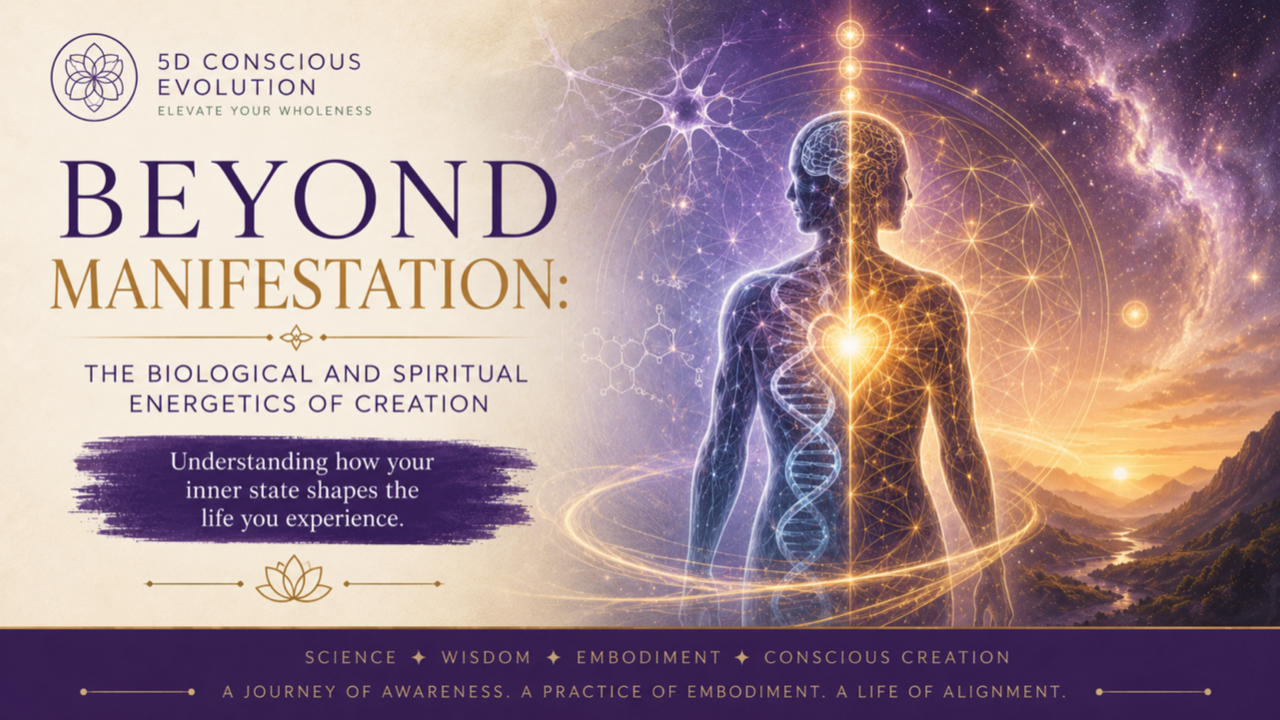
We Are Always Creating
Have you ever experienced that moment when you've known something for a long time, but for some reason you're only just beginning to understand the depth of its wisdom?
There is a phrase I've heard throughout the personal development and spiritual communities for years:
We are all creators.
Perhaps this idea is completely new to you. Perhaps you've heard it countless times. Or maybe you've accepted it intellectually but never stopped to consider what it actually means or why it matters.
That was my experience.
For years I understood the words, but only recently have I begun to appreciate the profound implications of what they reveal about the human experience.
If we are always creating, then what exactly are we creating?
How are we creating it?
And perhaps most importantly, how do we become conscious of this process rather than allowing it to unfold unconsciously?
These questions sit at the heart of conscious evolution.
In this article, I'd like to explore them from two seemingly different perspectives: biology and ancient wisdom. While they use different language to describe the human experience, I believe they point toward a remarkably similar truth. Together, they reveal that creation is not something we occasionally do; it is something we are continually participating in.
Before we explore how we can consciously direct this process, we must first understand the incredible intelligence already operating within us.
The Biological Energetics of Creation
One of the most extraordinary functions of the human brain is its ability to create coherence between our inner and outer worlds. Every second of every day, our nervous system is receiving an unimaginable amount of information through our senses. Light enters our eyes. Sound waves vibrate against our ears. Temperature, touch, taste, and smell continually provide information about the environment around us.
These experiences begin as energy.
Our nervous system receives these signals and translates them into electrochemical activity within the brain. Neurons communicate through electrical impulses and chemical messengers called neurotransmitters, allowing the body to interpret what is happening and respond accordingly. In this way, what began as patterns of light, sound, or vibration becomes a biological experience that we perceive, feel, and ultimately act upon (Lipton, The Biology of Belief).
This is why every emotional experience has a biological counterpart. When we perceive danger, stress hormones such as cortisol prepare the body for action. When we experience connection and trust, neurochemicals such as oxytocin support bonding and feelings of safety. Energy is continually being transformed into biology.
Albert Einstein famously observed that "Energy cannot be created or destroyed; it can only be transformed." While he was describing a fundamental principle of physics, I often find myself reflecting on those words when considering the human experience. What begins as information from the world around us is continually transformed into thoughts, emotions, chemistry, behavior, and lived experience.
Our biology is not passively observing reality.
It is actively participating in it.
This participation becomes even more fascinating when we consider what we call the mind.
While we often think of the mind as a single thing, it is helpful to distinguish between two different modes of processing. The first is the conscious mind, associated primarily with the prefrontal cortex. This is the part of us capable of reasoning, planning, imagining the future, and making intentional decisions.
Bruce Lipton describes this beautifully in Spontaneous Evolution:
"Self-consciousness enables an individual to factor in the consequences of his or her actions, not only in the present but also in the future. Self-consciousness is what enables us to be co-creators, not merely responders to stimuli."
Yet despite how significant our conscious awareness feels, it represents only a small portion of our mental activity.
The subconscious mind is continually monitoring both our internal and external environments, processing enormous amounts of information beneath conscious awareness. Lipton notes that while the conscious mind processes roughly forty bits of information per second, the subconscious is capable of processing millions of bits during that same time. Whether or not those exact figures are interpreted literally, the broader point remains compelling: most of what influences our thoughts, emotions, behaviors, and perceptions occurs outside of conscious awareness.
Why does this matter?
Because if our subconscious is directing the overwhelming majority of our responses to life, then it is also directing the overwhelming majority of how we participate in the process of creation.
This participation is not random.
Throughout our lives, the brain continually strengthens neural pathways based on repeated experiences. Rather than creating an entirely new pathway every time a signal travels through the nervous system, the brain builds efficient networks that allow familiar thoughts, emotions, and behaviors to become increasingly automatic. This remarkable capacity—known as neuroplasticity—is one of the reasons the human brain is capable of continual adaptation throughout life.
These neural pathways become the architecture of our habitual way of being.
They influence what captures our attention, how we interpret events, what emotions arise, and the behaviors that naturally follow.
Many of these patterns begin remarkably early in life.
During childhood, particularly in the first several years, the brain spends much of its time in slower brainwave states associated with heightened learning and suggestibility. During this period, children are continually absorbing information about themselves, relationships, safety, love, success, and what they believe is possible. Long before we consciously choose our beliefs, many of them have already begun choosing us.
This is not a cause for blame. It is an invitation toward understanding because the patterns that once helped us survive are not necessarily the same patterns that allow us to thrive.
Through this understanding, we’re now seeing how the nervous system doesn't simply respond to the world—it learns from it.
Every meaningful experience strengthens certain neural pathways while allowing others to weaken. Over time, these repeated patterns become our default way of perceiving life. We begin expecting similar outcomes, noticing similar details, and responding in familiar ways. Without realizing it, our past quietly becomes the lens through which we interpret the present.
Bruce Lipton summarizes this beautifully when he writes, "Perceptions are beliefs that permeate every cell. Simply, the expression of the body is a complement to the mind's perceptions" (Spontaneous Evolution, p. 26). He goes on to explain that perceptions not only influence behavior, but also affect the biological environment surrounding our cells, ultimately influencing gene expression.
Whether viewed through neuroscience or epigenetics, the implication is profound. Our beliefs are not merely abstract ideas living in the mind. They shape the chemistry of our bodies, influence our physiology, and become the lens through which we experience reality.
Imagine two people walking into the exact same room. One immediately notices warmth, kindness, and opportunity. The other notices judgment, rejection, and potential danger. The room hasn't changed. The people have. Their nervous systems are filtering reality through different histories, different beliefs, and different expectations.
This is one of the brain's greatest gifts—and sometimes, one of its greatest limitations.
Our brains are constantly searching for coherence. Once a belief becomes established, our attention naturally begins collecting evidence that supports it while overlooking evidence that contradicts it. Psychologists often refer to this tendency as confirmation bias. William James, often regarded as the father of American psychology, observed over a century ago that our experience is largely shaped by what we choose—or are conditioned—to pay attention to.
A simple exercise illustrates this beautifully. Pause for a moment and look around the room you're in. Find everything that is blue.
Take a few seconds.
Now shift your attention and begin looking for everything that is red.
Did the blue disappear?
Of course not.
Your attention simply changed.
The world remained the same, yet your experience of it transformed because your mind began searching for something different.
The same process is occurring every moment of our lives. If we believe people are trustworthy, our minds naturally recognize evidence that supports that belief. If we believe people are dangerous, we become exceptionally skilled at finding evidence for that instead. Neither person is intentionally creating a false reality; they are participating in reality through different perceptual filters.
This is why awareness is so essential. Until we become conscious of the beliefs shaping our perception, we unknowingly continue reinforcing them. The subconscious mind faithfully repeats the patterns it has learned, not because they are necessarily true, but because they are familiar.
Carl Jung expressed this idea in a way that has echoed throughout psychology for generations:
"Until you make the unconscious conscious, it will direct your life and you will call it fate."
I believe this statement captures one of the deepest invitations of conscious evolution. Much of what we call fate may simply be unconscious participation. That doesn't mean we control every circumstance we encounter. Life will always contain uncertainty, loss, injustice, and experiences beyond our control. But it does suggest that within every circumstance lies something we do have influence over: our participation.
This brings us to an important question. If biology explains how our perceptions become thoughts, emotions, chemistry, and behavior, how have ancient wisdom traditions understood this same process?
The Spiritual Energetics of Creation
Long before neuroscience gave us language for neural pathways, neurotransmitters, and the subconscious mind, ancient traditions were asking many of the very same questions. How does consciousness become lived experience? How does the invisible become visible? How does potential become reality?
Within the yogic tradition, one answer is found in the Sushumna Nadi, the central energetic channel said to run along the spine. Along this channel are the seven primary chakras, each representing a different quality of consciousness and a progressively denser expression of life. While the language differs from modern biology, I find it remarkable that both perspectives attempt to describe the movement between consciousness and physical experience.
The chakra system can be understood as a map illustrating how awareness gradually becomes embodied. Creation begins in its most subtle form—as pure consciousness, possibility, intention, and Spirit. As this energy descends through the chakras, it gradually becomes denser, taking on greater form and expression until it reaches the physical world.
The Crown Chakra represents our connection to universal consciousness and infinite possibility. The Third Eye gives rise to vision, imagination, and insight. The Throat begins organizing these possibilities into communication, intention, and expression. At the Heart, those ideas become infused with meaning, compassion, and emotion. The Solar Plexus transforms them into personal power, conviction, and purposeful action. The Sacral Chakra brings movement, creativity, and relationship, while the Root Chakra anchors the entire process into the physical body and tangible experience.
This is the descending current of creation: consciousness becoming matter.
Yet creation does not only move in one direction. Every experience we have also begins the journey home. Our actions generate consequences. Our relationships evoke emotion. Our emotions shape new beliefs. Those beliefs expand—or sometimes limit—our awareness. As we consciously integrate our experiences rather than unconsciously repeating them, the movement of energy begins to rise once again toward understanding, wisdom, and greater consciousness. This is the ascending current: matter becoming consciousness.
Seen this way, life itself becomes an ongoing conversation between Spirit and embodiment—between potential and experience, between becoming and remembering. Whether these teachings are understood literally, metaphorically, or somewhere in between, they invite us to consider a beautiful possibility: perhaps every moment of our lives is participating in this continual movement between consciousness and form.
Where Science and Spirituality Meet
As I have continued studying biology, psychology, philosophy, and ancient wisdom traditions, I have become less interested in asking which perspective is right and more interested in understanding what each perspective can teach us about the human experience.
Science provides us with an extraordinary understanding of the biological mechanisms taking place within the body. Ancient traditions offer symbolic and energetic maps that help us understand consciousness, meaning, and our relationship with life. While they often use different language, I believe they are pointing toward a remarkably similar truth.
Both suggest that our inner world continually influences how we experience our outer world.
Biology explains how information becomes chemistry, chemistry becomes emotion, emotion becomes behavior, and behavior becomes lived experience. Yogic philosophy describes this same movement as consciousness expressing itself through progressively denser layers until it becomes embodied as physical reality.
Different maps.
The same landscape.
Rather than asking us to choose between science or spirituality, perhaps the invitation is to allow each perspective to deepen our understanding of the other.
This naturally leads to another question.
If our biology and our consciousness are continually participating in the creation of our lived experience, how do we actually become aware of that process in our everyday lives?
For me, that question became the inspiration for developing what we call the 5 Dimensions of [Self].
The 5 Dimensions: The Practice of Conscious Creation
In my previous journal article, WHOLEistic Balance: The Alignment Beneath Balance, I explored the five interconnected dimensions that shape every aspect of the human experience: the Physical, Emotional, Mental, Spiritual, and Social dimensions of [Self]. Rather than revisiting that framework in depth here, I invite you to read that article first if these concepts are new to you.
What I would like to explore now is how those same five dimensions provide a practical framework for conscious creation.
One of the greatest challenges of studying consciousness is that it can quickly become abstract. We begin talking about energy, awareness, subconscious programming, or quantum possibilities, yet we are left wondering how any of those ideas relate to the realities of everyday life.
The beauty of the 5 Dimensions is that they bring these teachings into direct experience. At any moment throughout the day, we can pause and simply observe the quality of our state: How does my body feel? What emotions am I embodying? What thoughts or beliefs are shaping my perception? How connected do I feel to my purpose, values, or something greater than myself? How am I showing up in my relationships with others?
These questions may appear simple, yet they reveal something profound. Our thoughts do not exist independently from our emotions. Our emotions influence the physiology of the body. The body affects the clarity of the mind. Our relationships influence our beliefs. Our beliefs influence how we perceive opportunity. Everything is continually influencing everything else. The five dimensions are not separate parts of who we are. They are expressions of one integrated human experience.
As they begin moving into greater harmony, something remarkable happens. Our state changes. This, I believe, is one of the most overlooked principles of personal growth.
Most of us spend our lives trying to change our circumstances while paying very little attention to the state from which we are engaging those circumstances. We become consumed with changing our career, our finances, our relationship, or our health, assuming that once those things improve, we will naturally become happier, more peaceful, more confident, or more fulfilled.
But what if we have the equation backwards?
What if our greatest creative power does not begin with changing our circumstances, but with changing the quality of our participation? Our state influences what we notice. It influences what we believe is possible. It influences the conversations we have, the opportunities we recognize, the decisions we make, and the actions we are willing to take. Our state determines how we participate. And our participation continually shapes the life we experience. This does not mean we control every circumstance that enters our lives. Far from it. There will always be moments of uncertainty, heartbreak, illness, disappointment, and circumstances beyond our control. Conscious evolution is not about pretending those experiences don't exist, nor is it about blaming ourselves for everything that happens. It is about remembering that while we cannot always choose what life places before us, we can cultivate the state from which we choose to meet it.
Viktor Frankl, psychiatrist and Holocaust survivor, captured this beautifully when he wrote, "Between stimulus and response there is a space. In that space is our power to choose our response. In our response lies our growth and our freedom."
To me, this is one of the clearest expressions of conscious evolution. Not because we control life, but because we always retain the capacity to participate more consciously than we did before.
From Outside-In Living to Inside-Out Creation
Perhaps one of the greatest misunderstandings of modern culture is not that we have forgotten we are creators, but that we have forgotten where creation begins.
Here’s one of the ways this realization has changed my views of success- For much of my life, I believed success was primarily determined by what I did. The equation I unknowingly lived by was simple: work harder, sacrifice more, stay busy, and eventually life will reward your effort. Looking back, I often describe that season by saying my success was twenty percent who I was and eighty percent what I did.
That belief wasn't wrong. It served me for many years. It taught me discipline, perseverance, and responsibility. At sixteen years old, it was exactly the lesson I needed to learn.
But as I continued growing, I realized that belief could only take me so far.
I began noticing that the people I admired most weren't simply doing extraordinary things. They had become extraordinary in the way they thought, loved, served, and carried themselves. Their actions were simply an expression of the person they had become. As I began to integrate this new understanding, my equation began to reverse. Today, I would describe it very differently. My success is eighty percent who I am and twenty percent what I do.
That shift changed everything because instead of constantly asking, What do I need to do next? I began asking: Who am I becoming? What qualities do I want to embody before my circumstances change? Can I cultivate peace before life becomes peaceful? Can I practice gratitude before I receive everything I desire? Can I embody abundance before I see it reflected in my bank account? Can I become the kind of person who naturally recognizes opportunities that a fearful version of myself would never have noticed?
As I committed to that practice, something remarkable began to happen. My circumstances didn't change overnight, but I did. I found myself having different conversations. I noticed opportunities I would have previously overlooked. I made decisions from a place of trust rather than fear. My relationships deepened. My confidence grew—not because of external validation, but because I was learning to embody the qualities I had once believed success would eventually give me. Over the course of two months, more than sixteen thousand dollars of unexpected income came into my life. People often hear stories like this and immediately label them as manifestation. Personally, I don't think that language fully captures what happened. I don't believe I magically attracted money into my life. I believe I became someone capable of participating differently.
My state changed. Because my state changed, my perception changed. Because my perception changed, my decisions changed. Because my decisions changed, my actions changed. And because my actions changed, my life began changing as well.
To me, this is the true power of embodiment.
The goal is not to pretend we already possess everything we desire. Nor is it to ignore the realities of our lives in hopes that positive thinking alone will transform them. The invitation is much deeper than that.
Embodiment asks us to begin cultivating, today, the qualities we hope our future circumstances will eventually provide. As those qualities become integrated into who we are, they naturally influence how we perceive, relate, choose, and participate. The outer world often changes, not because reality suddenly became different, but because we did.
This is why I believe life so often acts as a mirror.
Not because every difficult experience is something we consciously created, nor because every painful circumstance is somehow our fault. I believe that perspective can become both discouraging and dismissive of the genuine suffering people experience.
Instead, I see the mirror as an invitation toward awareness: If I continually experience conflict, where might conflict still exist within me? If I find myself overwhelmed by chaos, where in myself have I lost alignment? If I repeatedly struggle to trust others, what beliefs or past experiences continue shaping the way I interpret the world?
The mirror is not asking us to assign blame. It is inviting us to become curious because curiosity leads to awareness and awareness creates choice.
Throughout this article, we've explored the process of creation through the lenses of biology and ancient wisdom. We've seen that our perceptions influence our biology, our biology influences our state, and our state influences how we participate in the unfolding of our lives. We've also explored the chakra system as a symbolic map describing how consciousness becomes embodied and how our lived experiences, when consciously integrated, become wisdom.
The 5 Dimensions of [Self] provide a practical way to observe this process in everyday life. Rather than asking us to master complex theories, they simply invite us to notice the quality of our state. They remind us that our physical body, emotions, thoughts, spirit, and relationships are not isolated aspects of our lives but interconnected expressions of one whole human experience. As we cultivate greater harmony among these dimensions, we naturally begin participating in life from a place of greater alignment.
And perhaps that is what conscious evolution is ultimately about- Not becoming someone else. Not escaping the human experience. Not waiting for life to finally give us permission to feel whole. Rather, it is the lifelong practice of becoming increasingly aware of how we participate in the unfolding of our lives, choosing each day to embody qualities that reflect our highest expression of [Self]. As we do, our outer lives often begin reflecting the transformation that has already taken place within.
As we continue this journey together throughout the pages of the 5D Conscious Evolution Journal, my hope is not simply that you discover new ideas. My hope is that you begin recognizing the extraordinary intelligence already within you—the intelligence of your body, your mind, your heart, and your consciousness. Together they form one of the most remarkable systems of adaptation, healing, and creation we know of.
The journey of conscious evolution is not about becoming something you are not. It is about remembering—and intentionally embodying—who you have always had the potential to become.
_____________________________________________________________________
Integration
Understanding the process of creation is only the beginning. Lasting transformation does not occur simply because we learn a new concept—it occurs when we begin embodying it. Awareness allows us to recognize the subconscious patterns, beliefs, and energetic states that have been quietly shaping our lives. Embodiment is what gives us the opportunity to consciously choose a different way of participating.
Throughout this article, we've explored how biology and ancient wisdom both point toward a similar truth: we are continually participating in the creation of our lived experience. Every thought, emotion, belief, and action contributes to the state from which we engage the world. As our state changes, so too does our perception, our choices, and ultimately the life we begin creating.
This is the heart of conscious evolution. It is not about striving to become someone else, nor is it about trying to control every circumstance. It is the ongoing practice of becoming increasingly aware of the qualities we are embodying and intentionally cultivating greater alignment within the dimensions of [Self]. From that place, we naturally begin participating in life with greater clarity, purpose, and authenticity.
So before moving on, I invite you to pause for a few moments. Find a quiet space, take a few slow breaths, and approach the following questions with openness and curiosity. Rather than searching for the "right" answers, simply notice what is already present. Awareness is the first step toward conscious participation, and conscious participation is where meaningful transformation begins.
Reflection Questions
- Looking across the five dimensions of [Self], what qualities have you been embodying most consistently in this season of your life?
- What state have you been participating in most often? Is it one of trust or fear? Peace or overwhelm? Gratitude or scarcity? Curiosity or judgment?
- In what areas of your life does your external experience seem to be reflecting your current inner state?
- If you intentionally chose one quality to embody more fully over the next month, what would it be? How might that influence the way you think, feel, act, and relate to others?
- As you reflect on this article, what is one small shift you can begin practicing today that would bring greater alignment to your Physical, Emotional, Mental, Spiritual, or Social Self?
___________________________________________________________________________
References & Further Reading
Einstein, A. (n.d.). On the conservation of energy. (Commonly paraphrased as, "Energy cannot be created or destroyed; it can only be transformed.")
Frankl, V. E. (2006). Man's Search for Meaning. Beacon Press. (Original work published 1946.)
James, W. (1890). The Principles of Psychology. Henry Holt and Company.
Jung, C. G. (1964). Man and His Symbols. Doubleday.
Lipton, B. H. (2005). The Biology of Belief: Unleashing the Power of Consciousness, Matter & Miracles. Hay House.
Lipton, B. H., & Bhaerman, S. (2009). Spontaneous Evolution: Our Positive Future (And a Way to Get There from Here). Hay House.
Continue the Journey
If this journal entry resonated with you, I'd love to continue exploring these ideas together. Receive future Journal Entries, Reflections, and Insights on Conscious Evolution delivered directly to your inbox.
Thoughtful insights only. No spam, and you can unsubscribe anytime.
